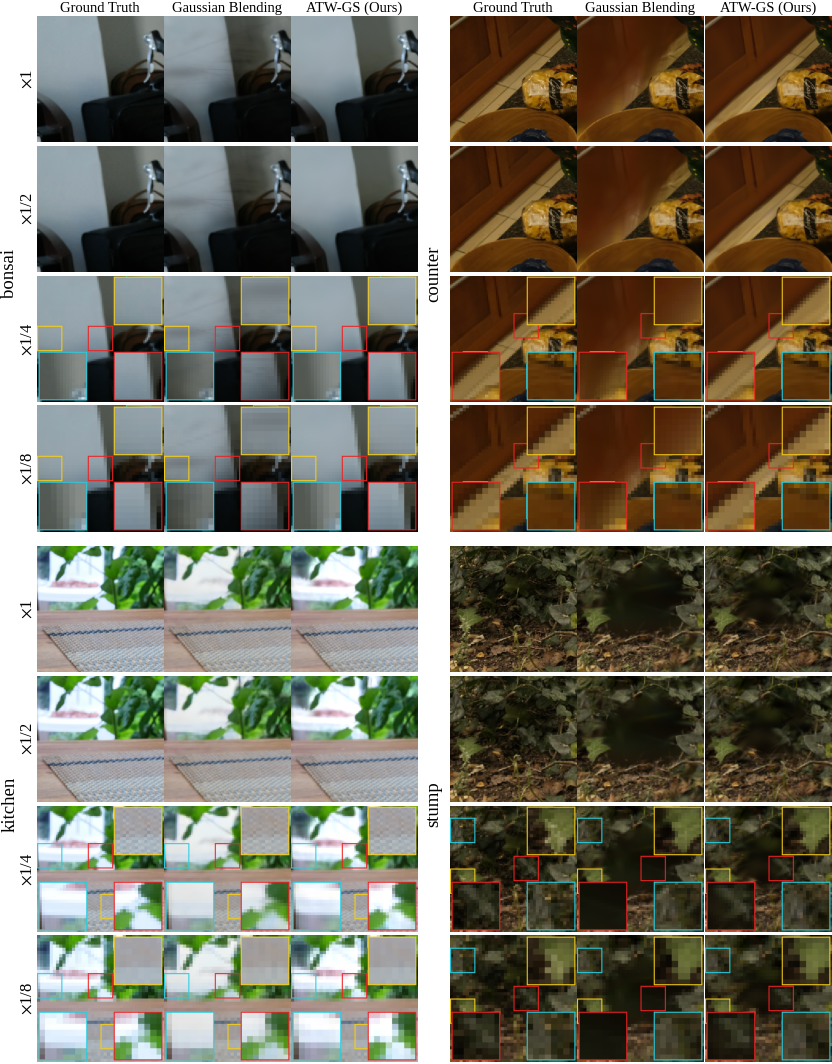
Multi-scale comparison on Mip-NeRF 360: ATW-GS suppresses the dilation that 3D Gaussian Splatting exhibits at sampling rates unseen during training, while preserving quality at the training rate.
3D Gaussian Splatting (3DGS) enables real-time novel view synthesis but suffers from aliasing artifacts when rendered at sampling rates that differ from those used during training. Existing anti-aliasing methods mitigate this issue by prefiltering Gaussian primitives or integrating their response over the pixel area; however, they rely on scalar alpha composition, which treats per-pixel transmittance as a single value and therefore discards the spatial structure within each pixel. More recent spatially aware approaches maintain a per-pixel transmittance window, but represent it as an axis-aligned box, preventing the model from capturing the true orientation of projected splats. To address this limitation, we propose Anisotropic Transmittance Windows for 3D Gaussian Splatting (ATW-GS), which models per-pixel transmittance as a full covariance Gaussian that preserves splat orientation throughout the front-to-back composition sequence. Furthermore, ATW-GS computes each splat’s contribution weight using the exact error-function integral of the pixel footprint projected onto the window’s marginal axes. This ensures consistency between the anisotropic window state and the per-splat weight computation. Extensive experiments on the NeRF Synthetic (Blender) and Mip-NeRF 360 datasets demonstrate that ATW-GS consistently outperforms state-of-the-art anti-aliasing methods across both single-scale and multi-scale evaluation regimes.
ATW-GS replaces point evaluation with an anisotropic per-pixel transmittance window propagated through alpha compositing, without changing the training pipeline.
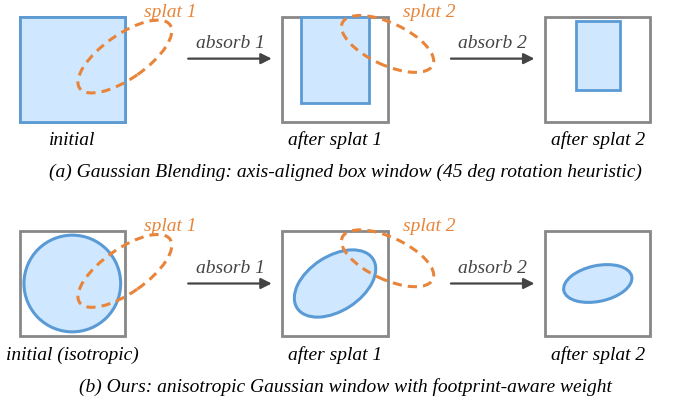
Point evaluation (3DGS): samples each Gaussian at the pixel centre and ignores the pixel footprint, so undersampling at lower render rates produces dilation and staircase artifacts.
Box transmittance window: integrates the footprint but keeps the window axis aligned, discarding the orientation of each projected splat.
Anisotropic transmittance window (Ours): propagates a Gaussian window with state $(M_0, \boldsymbol{\mu}_w, \Sigma_w)$ (mass, centre, and $2\times 2$ covariance) that tracks the residual unoccluded region as splats are composited front to back, and integrates each splat over its true oriented footprint.
Scale-averaged results on the Blender dataset. T4 reports PSNR only. Best per column in bold. Baseline numbers are taken from the Gaussian Blending paper, which evaluates all baselines under the same multi-scale protocol.
| Method | T1 (×1 train) | T2 (×1/8 train) | T4 (MS) | ||||
|---|---|---|---|---|---|---|---|
| PSNR | SSIM | LPIPS | PSNR | SSIM | LPIPS | ||
| TensoRF | 30.87 | .964 | .052 | 28.47 | .925 | .099 | 31.30 |
| 3DGS | 24.95 | .891 | .068 | 24.11 | .886 | .097 | 29.90 |
| Scaffold-GS | 24.92 | .895 | .070 | 22.37 | .862 | .121 | 28.48 |
| 2DGS | 23.79 | .867 | .095 | 25.94 | .909 | .104 | 28.47 |
| 3D-HGS | 25.19 | .896 | .066 | 24.38 | .887 | .100 | 30.99 |
| Tri-MipRF | 29.58 | .951 | .055 | 26.17 | .874 | .166 | 34.27 |
| Mip-Splatting | 31.73 | .973 | .028 | 29.64 | .939 | .084 | 34.72 |
| Analytic-Splatting | 31.59 | .972 | .030 | 29.53 | .933 | .077 | 35.07 |
| GB | 35.58 | .981 | .020 | 31.04 | .943 | .069 | 36.19 |
| ATW-GS (Ours) | 35.80 | .981 | .020 | 31.19 | .943 | .068 | 36.35 |
Scale-averaged PSNR on Mip-NeRF 360. Best per column in bold. Baseline numbers are taken from the Gaussian Blending paper, which evaluates all baselines under the same multi-scale protocol.
| Method | T3a (×1) | T3b (×1/8) | T3c (MS) |
|---|---|---|---|
| 3DGS | 23.68 | 22.25 | 27.55 |
| Scaffold-GS | 23.87 | 22.14 | 27.50 |
| 2DGS | 23.24 | 23.98 | 26.67 |
| 3D-HGS | 23.92 | 23.03 | 28.56 |
| Mip-Splatting | 28.47 | 27.15 | 29.25 |
| Analytic-Splatting | 28.23 | 26.34 | 29.21 |
| GB | 29.17 | 27.47 | 29.53 |
| ATW-GS (Ours) | 29.76 | 27.85 | 30.02 |
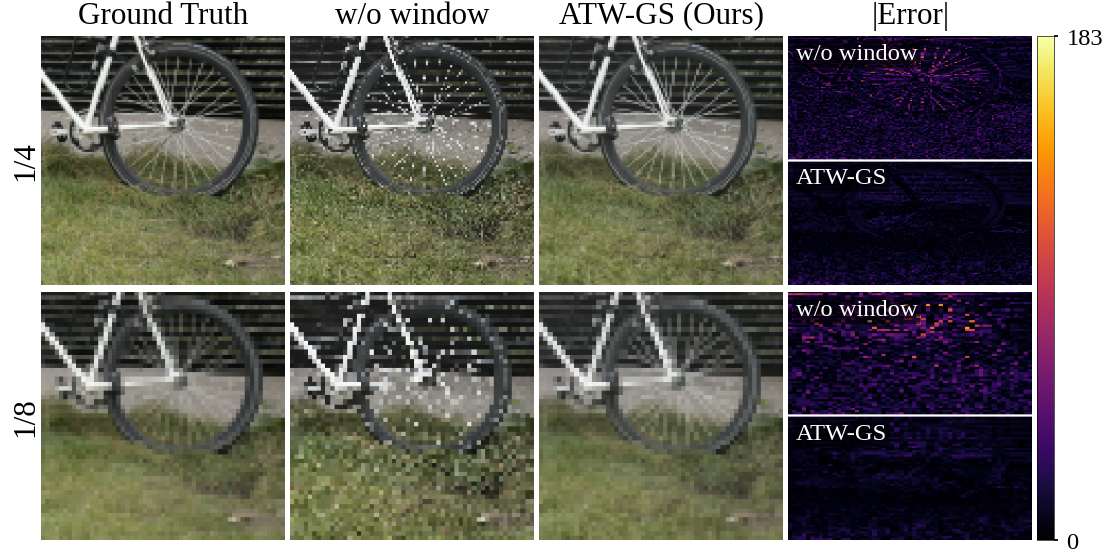
Effect of the transmittance window at reduced scales: point evaluation (w/o window) produces dilation that the anisotropic window removes, recovering the reference appearance.